
Discover how Southeast Asian students interpret credibility, value, and outcomes across UK TNE pathways
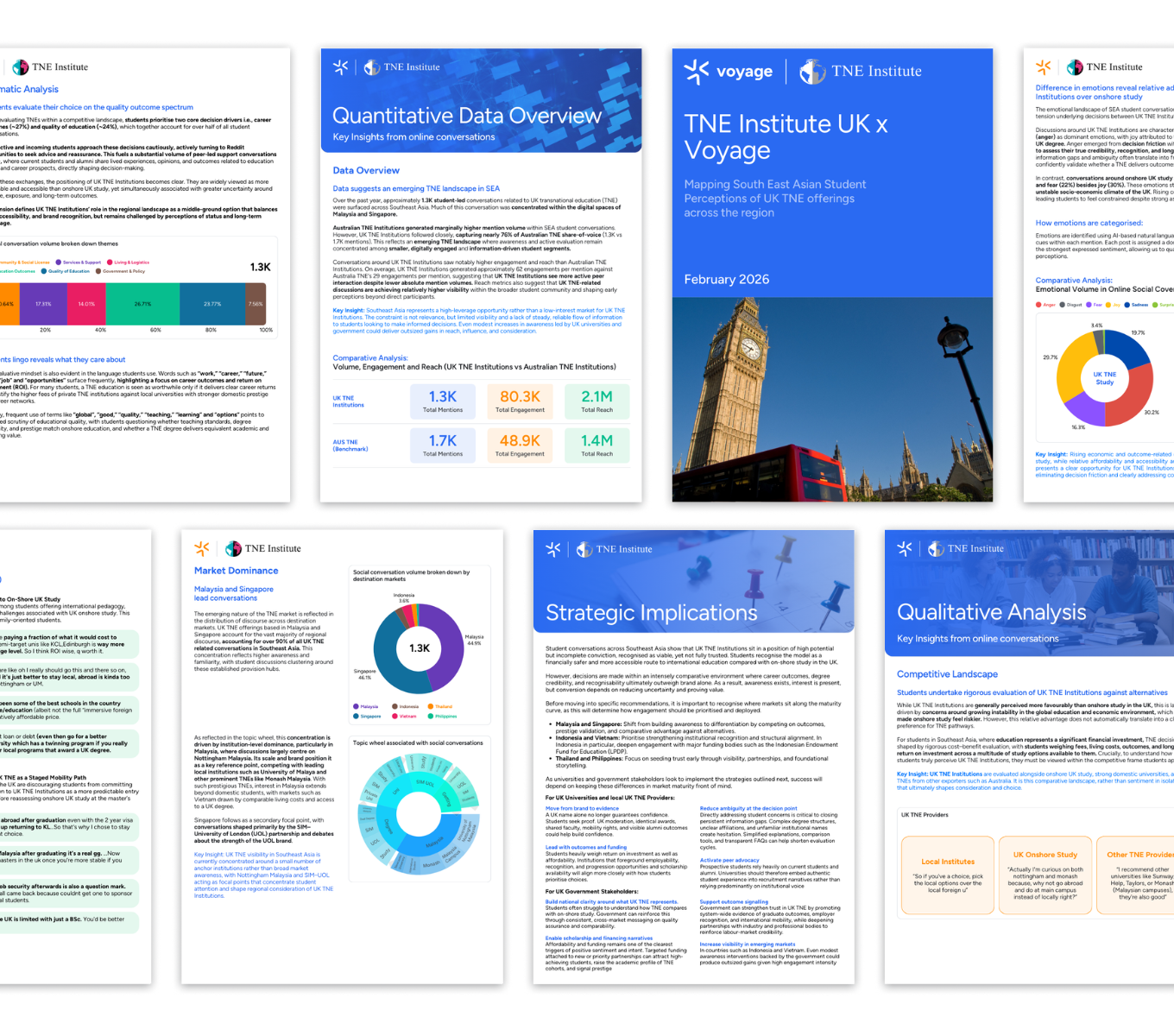
Across Southeast Asia, students are actively comparing UK transnational education with every alternative available; from onshore UK study and domestic universities to Australian branch campuses and private providers. their conversations reveal a region where interest is strong, but perceptions are still forming, shaped by peer-to-peer exchanges rather than institutional messaging.
This UK TNE Report surfaces the real-time conversations influencing how students assess credibility, value, and long-term opportunity across Malaysia, Singapore, Indonesia, Vietnam, Thailand, and the Philippines.
This is not survey data.
It reflects unprompted, student-led sentiment emerging from digital communities across the region - revealing the questions, doubts, and expectations shaping how learners interpret UK TNE today.
Download Your Free Report Now
What you'll uncover:
✔ How students across Southeast Asia compare UK TNE with onshore UK study, domestic universities, and Australian providers and the criteria they use to judge credibility.
✔ Why sentiment toward UK TNE is defined by cautious curiosity, with students seeking clarity on quality, recognition, and long-term outcomes.
✔ The emotional drivers behind TNE decision-making, including the tension between accessibility, affordability, and concerns about academic equivalence.
✔ How conversations about onshore UK study differ sharply, carrying heavier emotions tied to cost, risk, and return on investment.
✔ Signals from student-led digital spaces, where credibility gaps, comparison behaviours, and outcome-focused questions dominate the narrative.
This report helps you understand how Southeast Asia students perceive UK TNE today and the real dynamics shaping demand across one of the UK's most strategically important regions.
Your next strategy is grounded in real student voices, not assumptions.

Solid foundation
Benefit from insights and sentiments to enhance student experience, improve recruitment and retention, and benchmark performance across key markets.

Growth
Gain real-time visibility into international student sentiment to inform policy, improve outcomes, and strengthen global competitiveness.

Support
Monitor brand reputation, identify emerging trends, and uncover new business opportunities with international students.