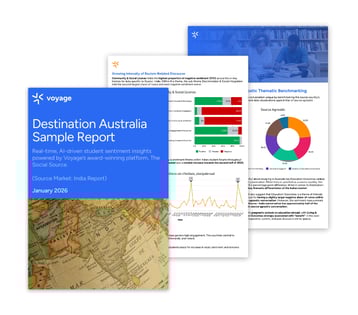

India remains one of Australia’s most strategically significant source markets but the forces shaping student decision‑making are shifting fast. Tightening migration settings, labour‑market uncertainty, and heightened discourse around racism and employability are reshaping how Indian students interpret opportunity, risk, and long‑term outcomes.
Voyage's Social Source platform captures these shifts in real time, surfacing unprompted conversations that reveal what traditional survey soften miss. What emerges is a portrait of a market that is informed, cautious, and increasingly vocal about the realities of studying abroad.
A market defined by high competition and low trust
Indian students rely heavily on peer‑driven digital spaces to navigate international education. Yet these same spaces are marked by deep scepticism. Advice, whether glowing or scathing is often met with doubt, and students frequently question the credibility of both official narratives and peer anecdotes.
The report describes this as a “low‑trust digital environment,” where even well-intentioned guidance is scrutinised.
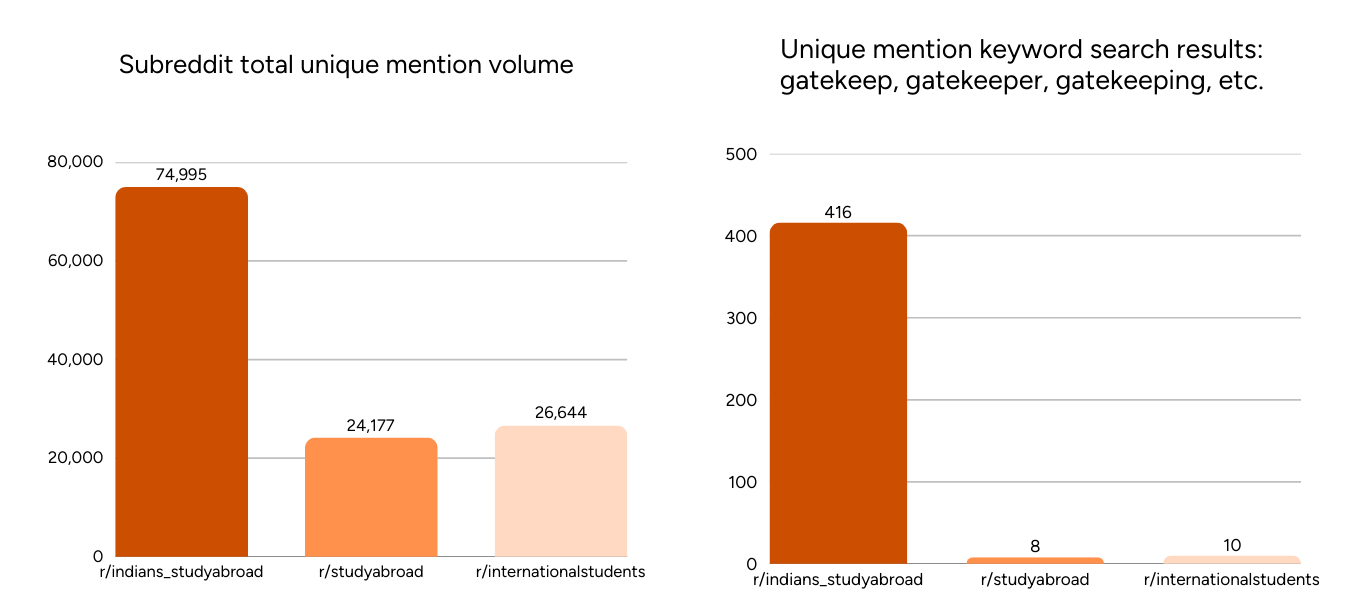
Rather than accepting information at face value, students interrogate it; comparing experiences, challenging assumptions, and weighing risks with increasing intensity. This dynamic shapes how they evaluate destinations, institutions, and pathways.
Racism and belonging: a growing emotional weight
Among Voyage’s six thematic pillars, Community & Social Licence carries the highest proportion of negative sentiment for Source: India. Within this, Discrimination & Social Integration stands out as both highly discussed and overwhelmingly negative. The report notes that this sub‑theme “held the second-largest share-of-voice and most negative sentiment overall.”
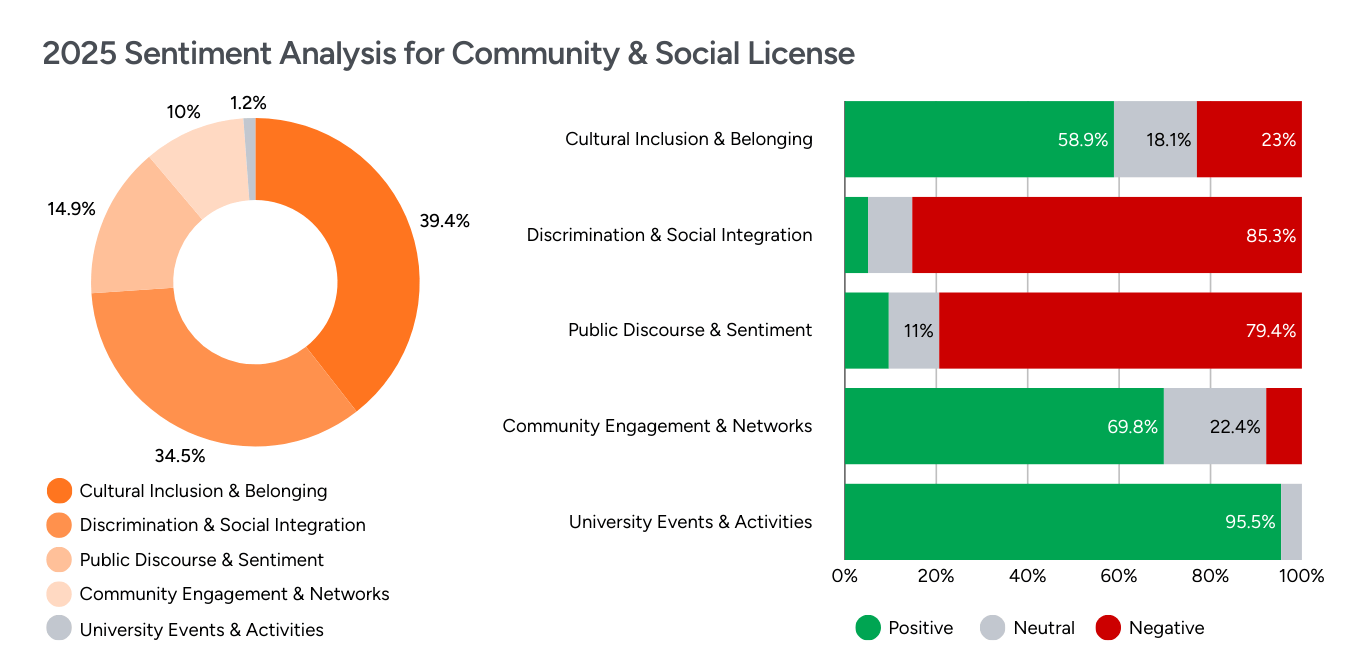
What’s notable is not just the presence of racism‑related discourse, but the way it intensifies around moments of public tension. Conversations spike when incidents abroad or at home raise concerns about safety, visibility, and belonging; shaping how students imagine their day‑to‑day lives in a new country. These emotional undercurrents are becoming a defining part of the decision‑making process for many Indian students.
Education outcomes and the cost-benefit lens
While global conversations about studying in Australia often highlight lifestyle or cultural experience, Indian students foreground something else entirely: return on investment.
The report shows a dramatic shift in thematic focus. When India is specified as a source market, the share‑of‑voice for Education Outcomes rises sharply; far more than in general conversation about studying in Australia.
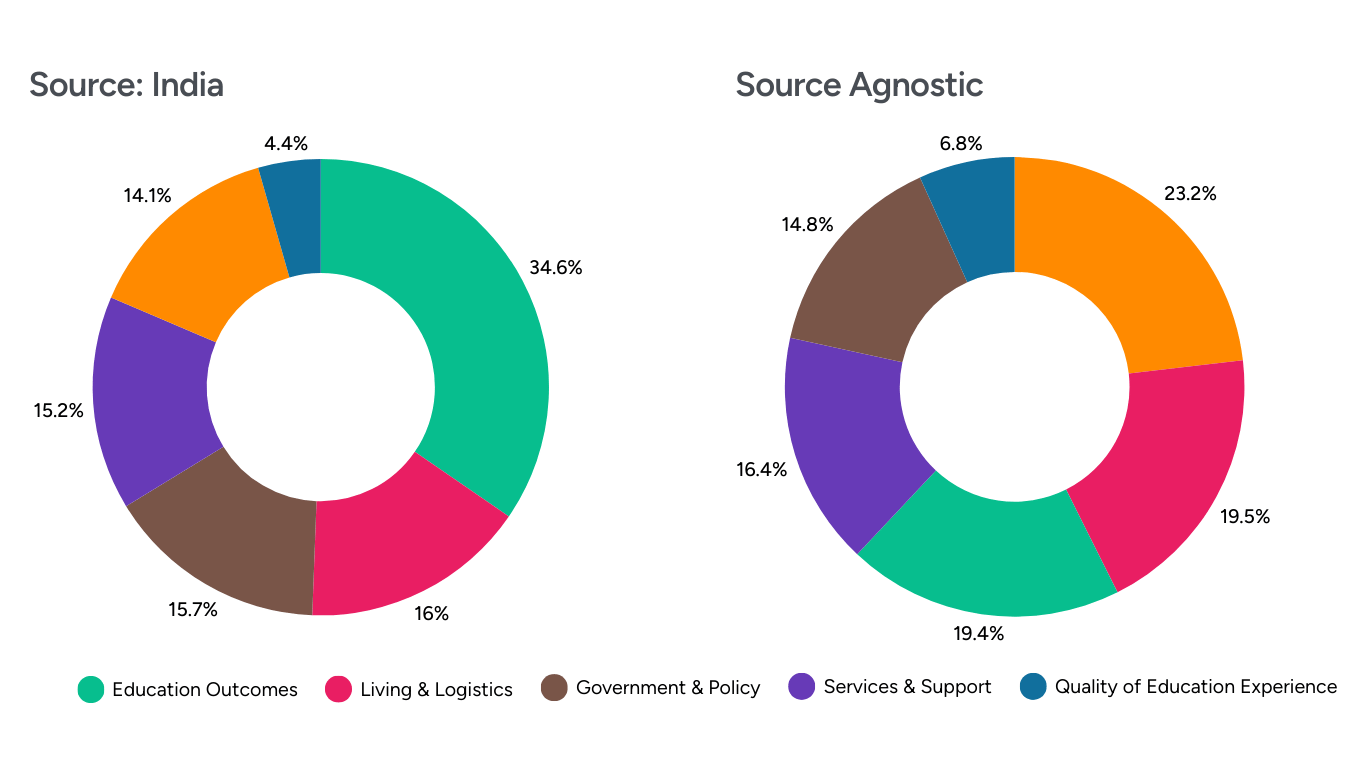
Students are explicit about the stakes. Rising costs, tightening migration pathways, and uneven employment outcomes have sharpened the focus on value. As the report explains, “Living & Logistics is directly linked to ‘cost’ and Education Outcomes strongly associated with ‘benefit’ in the cost-benefit analysis.”
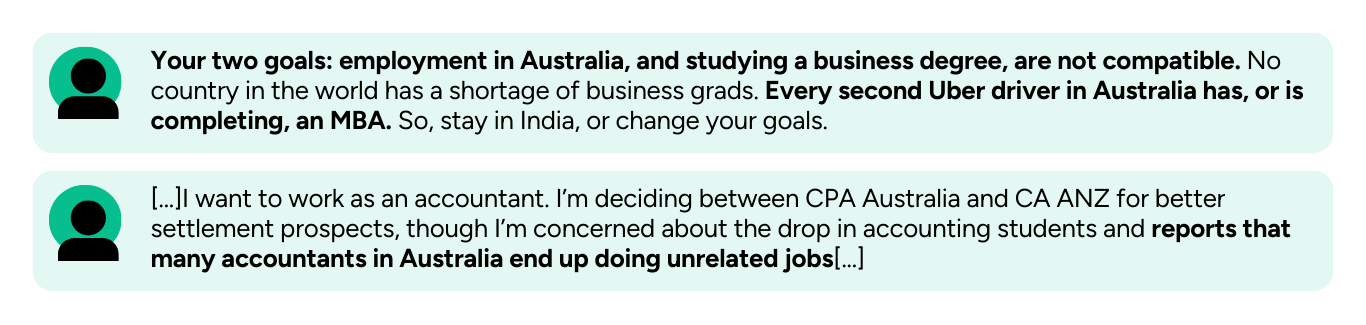
One motif captures this anxiety with striking clarity: the "Uber driver graduate". It appears repeatedly in Indian online forums as shorthand for a worst‑case scenario, a degree that doesn’t translate into high-skilled employment or long‑term mobility.
Rather than dismissing these fears, institutions need to understand what they represent: a deep concern about whether the investment in international education will pay off.
Living & Logistics: the hidden pressure point
Housing, transport, healthcare, and cost of living are not peripheral concerns; they are central to whether students feel they can succeed. The report notes that satisfaction with these factors “directly impacts their ability to focus on studies and integrate.”
For Indian students, these pressures are magnified by: rising rents, competition for part-time work, uncertainly post-study employment and the need to justify every dollar spent.
These conversations reveal how financial strain and logistical challenges shape perceptions of fairness, opportunity, and long-term viability.
A market that sees risk clearly and responds quickly
Across the dataset, Indian students emerge as:
- Highly informed
- Deeply peer-influenced
- Sceptical of official narratives
- Acutely aware of risk
- Increasingly vocal about negative experiences
They are nor just comparing destinations, there are comparing outcomes, pathways, and lived realities. And they are doing so in real time, through candid digital conversations that reveal the emotional and practical pressures shaping their decisions.
|
|
Interested in understanding how Indian students are really interpreting risk, value, and long-term opportunity?Get a first look at the real-time signals shaping Indian student decision-making. this sample report distils the pressures, expectations, and turning points influencing how students access Australia today. It offers a clear window into the conversations driving sentiment across one of the sector’s most critical markets. |